
Your resume has two jobs
READ TIME: 4 MINUTES
The morning of a round of interviews, I'd sit down with a stack of SaaS sales resumes and start at the bottom of the page.
Not the top. The bottom.
I wanted the story. Where you started, what you sold, how you moved. By the time I reached your current role, I already had a theory about you and three questions I planned to ask.
I'd also check LinkedIn to validate it and find any additional information.
Meanwhile, the recruiter who passed me that same resume had spent about 6 seconds on it.
Same document. Two completely different readings.
Here's the thing: your resume has two jobs.
Get through the recruiter skim so you land the call back.
Give the hiring manager a story worth preparing for, so they walk in excited to meet you. Not dreading the interview.
Most of the time I left the review with a list of questions because most resumes are missing critical information.
Today I'm showing you both readings from the inside.
The recruiter skim: 6 seconds
Yes, seconds.
Don't take my word for it. Laura Leach, former SaaS recruiter who's screened thousands of these, broke down her own process recently.
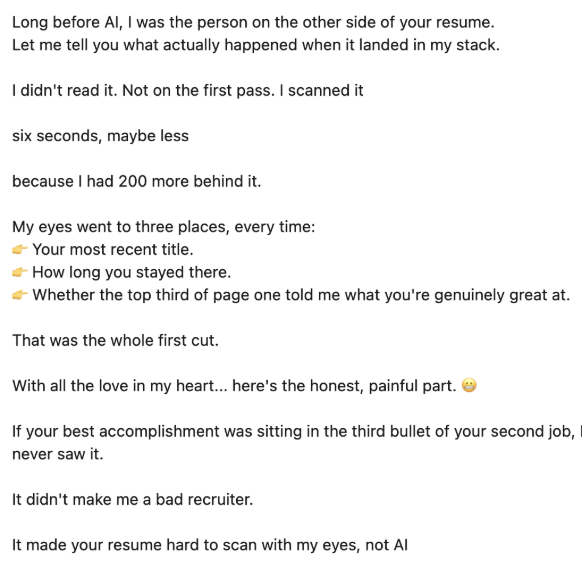
Your SaaS sales resume lands on a screen next to 200 others. The recruiter is scanning for a reason to keep going, not a reason to stop. You have to earn the scroll.
Four things make that happen:
Make your achievements impossible to miss. A key accomplishments section near the top, or bold them inside the role. President's Club, percent to quota (include the quota), ranking. If they have to hunt for the number, they won't.
Assume page 2 doesn't get read. Everything that decides the callback belongs on page 1, ideally above the scroll.
Make it obvious what you sold and who you sold it to. There are thousands of tech companies and new ones every day. "AE at Vertex" tells a recruiter nothing.
Five bullets per role. Maximum. Ten bullets isn't more evidence. It's more places to hide the evidence. Less is more. Get to the point. The goal is to get the interview.
The hiring manager read: what I was actually doing
Not every hiring manager reads your resume before the interview. Some only look at LinkedIn. Some wing it entirely.
But when I did read it, I wasn't screening you. You were already through.
I was trying to figure out your story. What skills you bring, what traits come through, where the gaps are.
Then I built my interview plan around two questions: what do I need to dig into, and what am I worried about?
Green flags I looked for:
Progression. Promotions, expanded territory, moving up market.
2+ years at a company.
Ranking, awards, President's Club.
Percent to quota and total dollars closed.
One specific deal I could ask about in detail.
Early in your career: did you work a job or play a sport while in college?
For leaders: all of the above, plus team size, how many people you hired, and what you owned beyond the number. The onboarding you rebuilt. The playbook you rolled out. The comp plan or territory design you changed. And most importantly the impact of that work, what metric changed and by how much?
Red flags I dug into:
Stints under 18 months.
Gaps with no context.
A list of responsibilities instead of results.
Pipeline with no closed business. $4M generated tells me nothing about whether you can close. Typically it's a sign that you're hiding you didn't close business.
And the gaps that were easy to fix, if anyone had told you:
What you sold and who you sold it to.
Numbers. Quota, ranking, percent to quota, number of people you mentored or led.
Company stage. If you're targeting early stage and you've spent five years at early stage companies, say it. Don't make me figure it out.
I was looking for relevant experience and evidence you've performed.
You don't have to have performed in every role. I expect you to miss quota at some point. Everyone does. And in this market I expect some shorter stints.
It's also more common now for people to take a break to travel, care for family, or handle something medical. Not every leader will understand that or be supportive of it. If they aren't, and that break is part of your story, that's not a flaw in your resume. That's a leader who isn't a fit for you, and you found out before you took the job.
Same rep. Two resumes.
Here's what all of this looks like on the page.
Version A
Account Executive, Vertex Software | 2022–2025
Responsible for managing the full sales cycle from prospecting through close
Built and maintained pipeline through outbound prospecting and networking
Collaborated cross-functionally with marketing and customer success
Utilized Salesforce to track activity and forecast accurately
Consistently exceeded activity targets and generated $4M in pipeline
Participated in onboarding and mentoring of new team members
Version B
Account Executive, Vertex Software | 2022–2025 Series B HR compliance software Sold to HR and Finance leaders at companies with 500–5,000 employees.
President's Club 2024. 137% to quota, $1.16M closed.
Ranked 2 of 24 AEs company-wide.
Closed largest new logo in company history: $310K ACV, 11-month cycle beating out competition by multi-threading across HR, Finance and IT through technical demos aligned to their needs.
118% to quota in first full year. Ramped 2 months ahead of plan.
Built the outbound sequence adopted team-wide, increased team pipeline by 40% in two quarters.
Same person. Same job. Same three years.
Version A cut by second 5, if it even makes it to the top of the stack. Version B gives the recruiter three reasons to keep reading and hands the hiring manager their first two questions.
Notice what changed. Nothing about the work. Only what got written down.
Hiring is a lot like dating
There's no perfect science to it.
Reading your resume is like reading a dating profile. What do we have in common, and what should I be concerned about? Someone decides in seconds whether to keep reading, and then spends real time looking for reasons to be interested or reasons to worry.
You can't control who swipes.
You can control what's on the profile.
Hit reply and tell me: what's the one thing your resume is missing that you added? I read every response.
To clarity and confidence in your career path,
Amanda
See you next Sunday.
Want to get this in your inbox every Sunday? Subscribe to the newsletter.
One email every Sunday. No spam. Unsubscribe anytime.
