
The Missing Piece in Your Sales Career
READ TIME - 5 MINUTES
It’s easy to remember your last big win. Can you remember what your performance looked like two quarters ago? What about three years ago?
Now imagine being asked in an interview, “Walk me through your results in your last role.”
Your memory alone won’t serve you.
That’s why today I’m walking you through the missing piece in your SaaS sales career: your brag book.
Without it, you lack the evidence needed to justify a raise, earn a promotion, or land your next role.
Lack of evidence, means lack of leverage.
This week, we’ll cover:
What a brag book actually is
Why it directly impacts compensation and advancement
What to include to clearly show revenue, influence, and scope
When to update it
How to use it in QBRs, reviews, interviews, and negotiations
What a brag book actually is
A brag book is a running record of your role, performance, wins, and impact.
It captures:
What you were responsible for
What you delivered
How you drove revenue, growth, or outcomes
Recognition and feedback that validates your performance
Think of it as your career CRM. “If it’s not in Salesforce, it doesn’t exist.”
Why it’s important
Your brag book is the foundation of your career narrative.
Here’s why it matters.
1. Reviews, Raises and Promotions
If your compensation or advancement isn’t based solely on quota, you need evidence. Annual reviews tend to overweight recent performance. A brag book ensures the full year, not just the last quarter, gets represented.
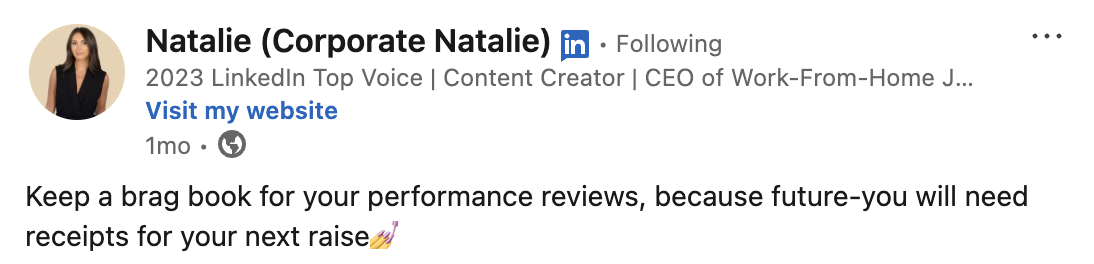
You don’t have to take my word for it, here’s how others, like Natalie, explain why it matters:
2. Interviews
When you’re asked to speak about a role from two or three years ago, memory alone won’t hold up. Interviewers don’t want generalities, they want specifics.
I learned this firsthand when interviewing for an EdTech role. The focus quickly narrowed to my experience at a previous EdTech company from three years earlier. Because I had kept a brag book, I could pull exact performance metrics, deal examples, and scope on the spot.
That’s the difference.
Specifics are proof.
Proof builds credibility.
Credibility wins interviews.
3. Resume and LinkedIn
When I work with clients to rewrite their resume and LinkedIn profile, the first exercise is documenting past roles, results, and projects aligned to the role they’re targeting.
This is where most people struggle.
Not because they didn’t do the work, but because they never captured it. That leads to watered-down resumes and missed opportunities.
If it’s not in your brag book, it’s not making it into your narrative.
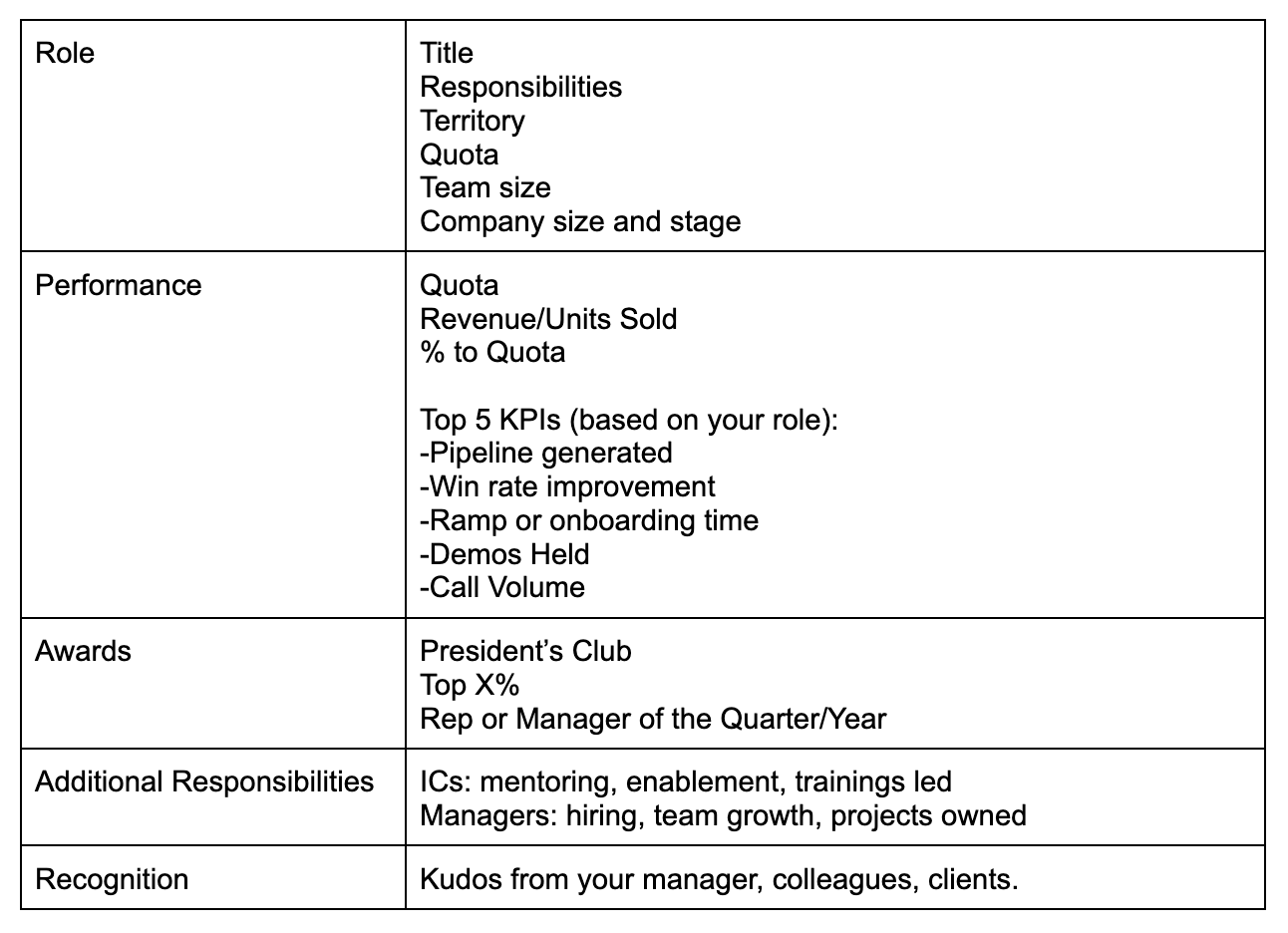
What to include (Revenue, Influence, and Scope)
Here’s a screen shot of a template as a starting point. If you want the full template as a Google document, click the link below.
When to Update It
Ideally, update your brag book as wins happen. That’s when it’s fresh.
If that’s not realistic, set a recurring reminder:
Monthly for Small Business sales cycle
Quarterly for Mid-Market or Enterprise sales cycle
If your company runs QBRs, that’s an easy trigger to update your brag book.
How to Use It
Your brag book is not a static document. It should be used regularly to support:
Performance reviews and QBRs
Promotion and compensation conversations
Resume and LinkedIn updates
Interview preparation
Offer and negotiation discussions
These are the proof points that make your career story credible. Without them, your narrative lacks specificity. In competitive hiring processes, that can cost you the role.
Key Takeaway
If you don’t have a brag book, start one today. Click the link below to get the template.
Document past roles, capture your impact, and set a recurring reminder aligned to your sales cycle.
This is how you take control of your career narrative instead of leaving it to memory or opinion.
Reply and let me know: how have you used your brag book or if you’re starting a new one was the template helpful?
To clarity and confidence in your career path,
Amanda
See you next Sunday.
Want to get this in your inbox every Sunday? Subscribe to the newsletter.
One email every Sunday. No spam. Unsubscribe anytime.
