
How to Make a Career Transition
READ TIME - 5 MINUTES
Last week, nearly every conversation I had started the same way:
“I’m looking to transition from X to Y.”
SMB → Mid-Market
Mid-Market → Enterprise
IC → Manager
Manager → Director
Technical Sales → SaaS Sales
Different paths. Same question:
“How do I land a role when I don’t have the exact experience they’re asking for?”
To answer that question, there are two things you must understand:
The role
Yourself
Whether this is an internal promotion or an external move, the process to manage a successful career transition is the same.
Step One: Know the Role
There are three effective ways to understand what a role actually entails.
1. Start With the Job Description (This Is the Answer Key)
Think of the job description like the answer key to an exam.
A hiring manager and recruiter have already aligned on:
The skills they need
The traits they value
Your job is to extract those signals.
Review the job description and highlight:
Core skills
Required experience
Repeated themes
You can absolutely use ChatGPT here:
“Pull out the key skills, traits, and repeated themes from this job description.”
This information becomes the foundation for how you position yourself — and where you may need professional development.
2. Talk to the Manager
This is where the job description comes to life.
If this is an internal move:
Identify who would manage you
Set up time proactively (even if the role isn’t open yet)
Make sure you’re performing well in your current role
Be sure your manager knows you are having the conversation
When I was promoted into my first management role, I sat down with the VP of Sales at Vocus and asked:
What traits do you look for when hiring managers?
What separates the strongest managers?
What would make me an obvious choice?
Months later, when the role opened, I entered the interview process with a clear advantage and landed it.
If you’re looking externally or currently unemployed:
Start with your network
Identify who you want to meet with
Enterprise AE → Enterprise Sales Manager
Sales Manager → VP or Director of Sales
If that falls short, leverage free SaaS communities like RevGenius, Women in Revenue, Women in Sales, or Modern Sales Pros to identify a mentor.
3. Talk to Someone Currently in the Role
Use a similar approach to your manager conversation.
This is where you’ll learn:
What the day-to-day actually looks like
How they made the transition
What helped them succeed
At this point, you have a clear picture of what the role entails and what success requires.
Sometimes, this leads to an important realization: you don’t actually want the role.
That’s a win. Better to know now than after making the move.
If you’re still aligned, the focus shifts to you.
Step Two: Know Yourself
1. Know Your “Why”
Before you move forward, get honest about your motivation.
Why this role? Why now?
In 2018 I pursued a VP Sales role for the first time in my career. Here was my why at the time:
Growth
Money
Travel
By 2021, my priorities had shifted. My partner and I wanted to start a family. Heavy travel was no longer appealing. Owning a national Enterprise team was likely off the table.
The role didn’t change.
My rubric did.
When you evaluate your “why,” your personal life matters.
2. Identify Gaps and Close Them Intentionally
If you’re missing experience, don’t panic. Be strategic.
Here are two examples:
Targeting an Enterprise role and the job description calls for MEDDIC or Challenger? Close that gap proactively with a course.
Want to manage? Start mentoring or leading informally now.
Hiring managers favor candidates who demonstrate the skillset before they interview.
3. Translate Your Experience (Where Most People Fail)
You don’t need identical experience.
You need relevant proof.
I worked with a client selling mostly SMB who wanted to move into Mid-Market.
We identified:
His three largest deals (they resembled Mid-Market complexity)
Multiple stakeholders
60-day sales cycles
$20K–$50K ACV
That became:
Clear KPIs on his resume
Confident, repeatable interview stories
That’s one way to bridge the gap. The second is incorporating the professional development you’ve completed.
Finally, unpack the traits the role requires.
Below is a screenshot from a job description (the answer key) I reviewed this week.
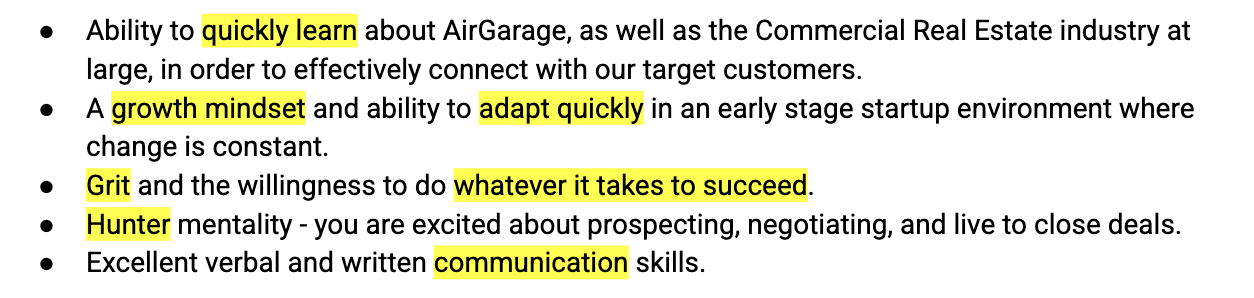
The traits that stood out:
Work ethic
Growth mindset
Grit
Hunter mentality
Communication
Next, align those traits with the ones you consistently demonstrate. You’ll highlight that in your resume and interviews.
If that’s not immediately clear, ask a former manager, mentor, or career coach for perspective. You can also use tools like StrengthsFinder, Sparketype, or VIA Character Strengths to clarify your strengths.
To recap, if you’re looking to make a career transition, here’s the framework to set you up for success.
Your Career Transition Framework
Know the Role
Job description = answer key
Manager and role-holder conversations
Know Yourself
Your “why”
Identify and close gaps
Translate your experience
You now have the framework. The next step is execution. Pursue the transition and position yourself to land the role.
Reply and let me know what type of career transition you’re targeting in 2026.
To clarity and confidence in your career path,
Amanda
See you next Sunday.
Want to get this in your inbox every Sunday? Subscribe to the newsletter.
One email every Sunday. No spam. Unsubscribe anytime.
