
How to Sell Yourself in an Interview
READ TIME: 5 MINUTES
You’re Not Selling Software in an Interview. You’re Selling You.
In software sales, the product is obvious.
It’s the software.
You know the elevator pitch.
You know how to uncover pain.
You know how to guide the conversation, overcome objections, and close the deal.
But interviews are different.
The product changes.
The product is you.
And surprisingly, this is where many great sellers struggle.
They know how to position a product.
They know how to run a compelling demo.
But when it comes to telling their own story, they get stuck.
Questions that should be simple suddenly become difficult:
What’s my elevator pitch?
Which examples best demonstrate what I’m capable of?
How do I talk about my experience without rambling?
How do I make my background relevant to this specific role?
And if I missed quota… how do I talk about my performance?
If you're pursuing a promotion, an internal transfer, or a new role externally, learning how to sell your story is critical.
Because hiring managers evaluate candidates the same way buyers evaluate software.
They want to understand:
What problem the product solves
Why it’s different
And whether it’s the right fit for their environment
The Structure of a Strong Candidate Story
The most effective candidates structure their story the same way great sellers structure a product pitch.
There are four core components.
1. Start With the End in Mind
In sales, the first step is understanding the customer’s pain.
What problem does the product solve?
Why would someone buy it?
Only once you understand that can you ask the right questions and position the solution effectively.
The same logic applies to interviews.
Before telling your story, ask:
What problem is this role solving?
For example:
Is the company looking for someone to drive heavy outbound net-new business?
Are they selling through long, complex enterprise deal cycles?
Is the focus on expanding existing customers?
Is the organization scaling a team or rebuilding one?
The job description and recruiter conversations provide valuable clues.
This context helps you tailor:
Your resume
Your LinkedIn profile
And the examples you share in interviews
2. Define What Makes You Different
Every strong product pitch highlights differentiation.
Your story should do the same.
What strengths consistently show up across your career?
For example, a strong Enterprise AE might be known for:
Core traits
Strong work ethic and persistence
Operating autonomously in complex environments
Core skills
Building partnerships that generate pipeline
Closing large, complex deals with multiple stakeholders
This becomes the headline of your story.
3. Provide Context
Hiring managers need context to evaluate your experience.
Without it, achievements are difficult to interpret.
That context typically includes:
What type of product you sold
Who you sold it to
Typical deal size
Sales cycle length
Complexity of the buying process
For leaders, it may also include:
Team size
Organizational structure
Scope of responsibility
Think of this as the product overview slide that frames everything that follows.
4. Run the Demo: Your Examples
The strongest candidates come prepared with specific examples that demonstrate how they operate.
Think of these as the demo of your product.
They show the hiring manager:
How you think
How you solve problems
How you drive outcomes
Many candidates worry they don’t have strong examples. Especially if they missed quota or went through a difficult year.
But when we start unpacking their experience, we almost always uncover meaningful wins.
For example, candidates I work with often surface stories like:
Growth & Impact
Scaling a team from 2 to 10 or 20 to 40
Helping drive year-over-year revenue growth
Deal Execution
Landing a large enterprise deal or securing a major logo
Navigating complex and competitive buying cycles with multiple stakeholders
Building New Motions
Building an expansion motion from $0 to $1M+
Building a new territory from 0 to 50+ customers
Early Performance Signals
Ramping the fastest in a cohort of new hires
Sometimes the example isn’t obvious until you step back and look at the bigger picture.
One Customer Success leader I worked with had missed their revenue targets during a difficult year. But during that same period, they built a business case for the executive team and board outlining product gaps and recommending a restructuring plan that improved efficiency and reduced costs. While the numbers weren’t ideal, the experience demonstrated leadership, strategic thinking, and influence.
Another client had missed quota but had successfully landed several large enterprise logos. Even though the revenue timing didn’t work in their favor, the deals required navigating complex buying processes and building executive relationships. Clear signals of enterprise sales capability.
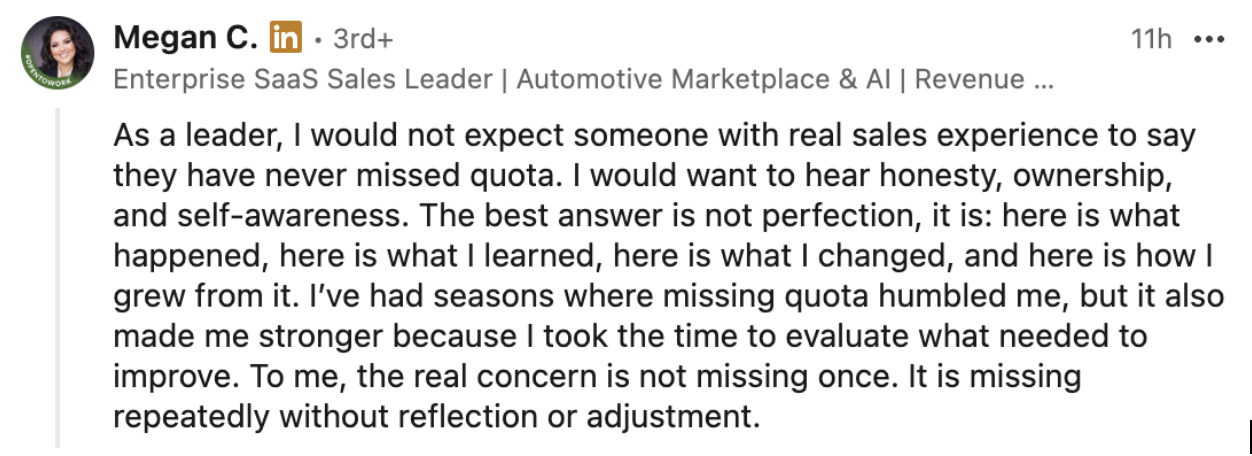
As a former hiring manager, I never expected perfection.
I’ve hired people who consistently exceeded quota at previous companies but struggled once they joined a new organization. Past performance can provide clues, but it doesn’t guarantee success.
What mattered most was whether the candidate demonstrated the skills, judgment, and resilience needed to succeed in the role.
In fact, some of my best hires were people who had faced setbacks but could clearly articulate what they learned and how they improved.
Here’s perspective from another sales leader:
Just like a strong product demo, the best examples are always:
Concise
Specific
Honest
Demonstrate self-awareness
Relevant to the role you're targeting
The Bottom Line
When you're interviewing, you're no longer selling software.
You're selling the product: your experience, your strengths, and your impact.
Just like a strong sales process, your story needs to be:
Clear
Structured
Relevant to the buyer
Because when hiring managers understand the value of the product quickly, the decision becomes much easier.
Hit reply and tell me one example you’re thinking about using in interviews. I’m happy to share feedback.
To clarity and confidence in your career path,
Amanda
See you next Sunday.
Want to get this in your inbox every Sunday? Subscribe to the newsletter.
One email every Sunday. No spam. Unsubscribe anytime.
