
The job search she called lazy
READ TIME: 5 MINUTES
Megan was stuck and unhappy.
She was a sales manager at an organization she'd been at for over a year. Her team had months that were successful. Other months, they were short of the number.
There was constant turnover at the leadership level. A reorganization. And constant change management.
She wasn't sure if it was the chaos within the organization or the type of work she was doing. What was driving her unhappiness?
She knew she was unhappy. So unhappy it started to impact her well-being.
For a lot of us, we don't realize how much stress from work pulls on our health and our personal lives. The more that showed up for Megan, the more she realized it was time to leave.
But she wasn't 100% positive what to run towards. She just knew she needed to run away.
That was the initial work we did together. At one point, our clarity work brought us to potentially leaving corporate and sales leadership altogether.
Then something shifted inside her current organization. She was given the chance to do the work she loved most: coaching sales professionals and using data to inform that coaching.
Two reps. An outbound motion. Real time to coach and look at the numbers. She watched them start thriving, and watched other managers notice.
That reminded her what got her into sales management in the first place. And it helped her realize what she was running towards.
She didn't need to run away from corporate. She needed a better sales organization. One with less change management. One where she could thrive by focusing on the coaching she loved.
Many people know that it's time to leave, but struggle to define what they want.
Then when it's time to job search, they start the same way:
Update the resume. Scroll for openings. Apply online to everything. If they get an offer, they accept the wrong one and end up back where they started.
Megan took a different approach. As a mom, she called it the lazy approach, because she didn't have the bandwidth to go in and rebuild her LinkedIn profile or resume.
Here's what she did instead. Every month her team performed, she posted about their performance on LinkedIn.
Those posts drove 4 companies to reach out to her. She interviewed with 3. She landed 2 offers.
In her words: "I was just hoping to get some inbound traffic in a lazy way, to be totally honest."
Here's the kind of post she was putting out:
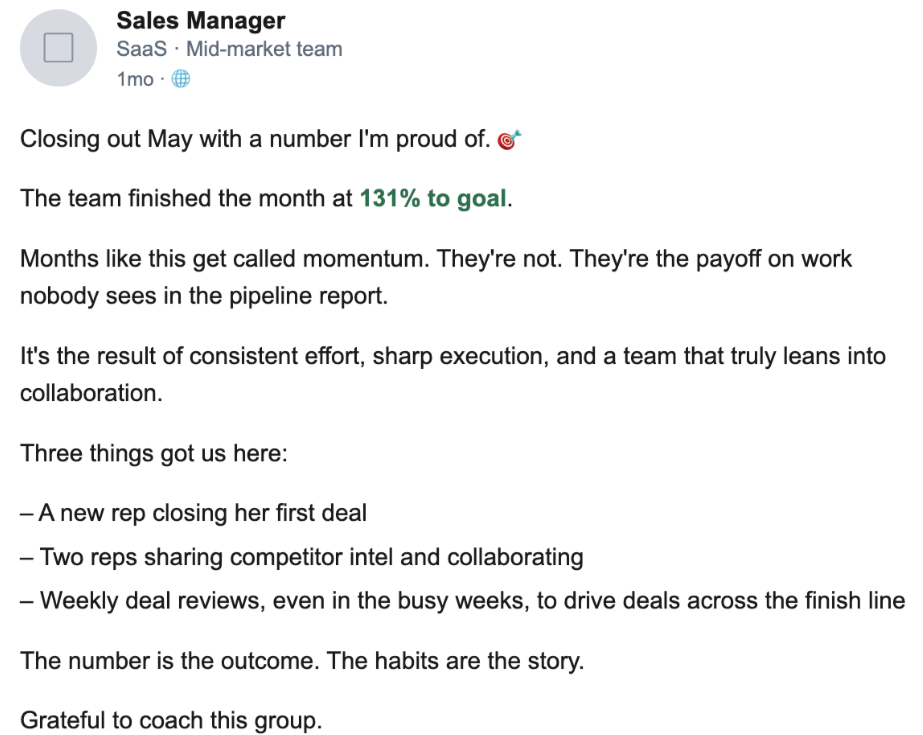
No "open to work." No ask.
Just the performance and the team behind it.
Every one of her posts had the same 3 parts:
The number, with a timeframe. Percent to goal, attainment, ranking — anchored to a month or a quarter. This is what recruiters search.
The credit. Points at the team. Tag them when it makes sense.
How they did it. 3 bullets on what actually drove the result.
That's it. Once a month.
Why her approach worked
Many of us are dormant on LinkedIn. Myself included, for years.
I'd post when I started at a new company. When I was hiring. A company update here and there.
But when you post about your performance, you're putting out results. That's what makes recruiters and hiring managers able to find you.
LinkedIn is a social platform that rewards you for being active, and posting is activity.
If you looked at Megan's profile, she wouldn't come up in a lot of recruiter searches. She didn't have much context under each role and company. Just her basic title and companies.
She didn't need it. It was in her posts.
If you want recruiters to find you on LinkedIn → here's how to update your profile.
Knowing how to hire doesn't mean knowing how to interview
Megan had crafted AE and SDR interview processes. Written job descriptions. Choose the questions asked in those interviews.
You'd think that gave her an advantage in interview prep.
But a lot of us who are great at hiring don't know how to translate that to preparing for our own interview.
It potentially cost her an offer at a company where she went 7 rounds deep. She was a leading candidate. Then 2 questions in one final round interview threw her off.
Here's what she told me later: "There were 2 questions they asked me and I was like, oh, I don't know how to answer this."
The worst part about getting 7 rounds deep and being a finalist is the hours you've invested and the feeling that things are going to work out. That this is your exit ticket to the new opportunity.
So when you get the call and it doesn't work out, it's crushing.
It was crushing enough that she debated staying in a bad situation and just keeping her head down.
What she did with the setback
Those LinkedIn posts kept working. More recruiters reached out.
But she didn't take every conversation. One company she turned down early because it didn't align with her target. Another she went all the way through, got an offer, and thought seriously about taking it.
After we worked through it, we aligned that it wasn't going to give her what she was looking for. She'd be right back in the same situation she was trying to leave.
"That's where you came in," she said. "You were like, what do you want? You're not going to want to travel. Be honest. And having the chance to verbalize that with someone who wasn't my husband and isn't as close to it helped me be more picky rather than desperate."
That's when it clicked for her. It wasn't worth running from something. She needed to know what she was running towards, and evaluate every company and role against it.
Then we rebuilt her interview prep.
We broke down the job description. For each thing they were looking for, we mapped the examples she already had.
"That is honestly something I never thought about going through an interview process. Breaking down the job description and having those examples ready."
She used that same process for the company she ended up landing. Her words: "While it might not be the exact answer, there are still examples within that I can pull from and make relevant. I was much more linear in my thinking."
She landed a sales manager role with the chance to improve coaching processes inside the organization. Exactly what she wanted.
On the negotiation
She was prepared to negotiate for more salary, a signing bonus (since she was leaving commission on the table) and 3 months of guaranteed commission.
Even though she was prepared, she still thought about just accepting. The morning of the negotiation she sent me this meme: "Good news! After overthinking it for 6 hours and letting it consume my every thought, I've decided it's not that big of a deal."
Then she went into her negotiation.
Here's what she learned about how to negotiate without losing the offer: structure the ask so you're not coming across as ungrateful. You still emphasize how excited you are and how much you're looking forward to the opportunity. And you communicate your worth at the same time.
It's a mutual agreement, not one-sided.
Knowing your worth. Knowing it's okay to ask for more. Knowing you're not going to lose the opportunity because you did.
She landed the guarantee and signing bonus for a total of $42K.
Why she says the coaching was worth it
I asked her directly. Here's what she said:
"It's worth making the investment because when you're switching careers or putting time and energy into a job search, that's an investment in your future. You want to optimize that so when the perfect opportunity does come across, you're fully prepared for it. You're not losing out on something that would be a great fit for lack of preparation."
And when I asked her to describe what the coaching did in one sentence:
"You provided consistent reminders of my worth as a professional, gave me clarity on what I was looking for, and a path to get there."
Megan's search was a clarity project. Focused on what she was running towards.
She let her results do the sourcing and she did the prep work to nail the interviews and offer.
That's how she went from unhappy and stuck to excited and ready to get back to the work she loved.
Hit reply and tell me: are you running away from something, or towards something? I read every response.
To clarity and confidence in your career path,
Amanda
See you next Sunday.
Want to get this in your inbox every Sunday? Subscribe to the newsletter.
One email every Sunday. No spam. Unsubscribe anytime.
